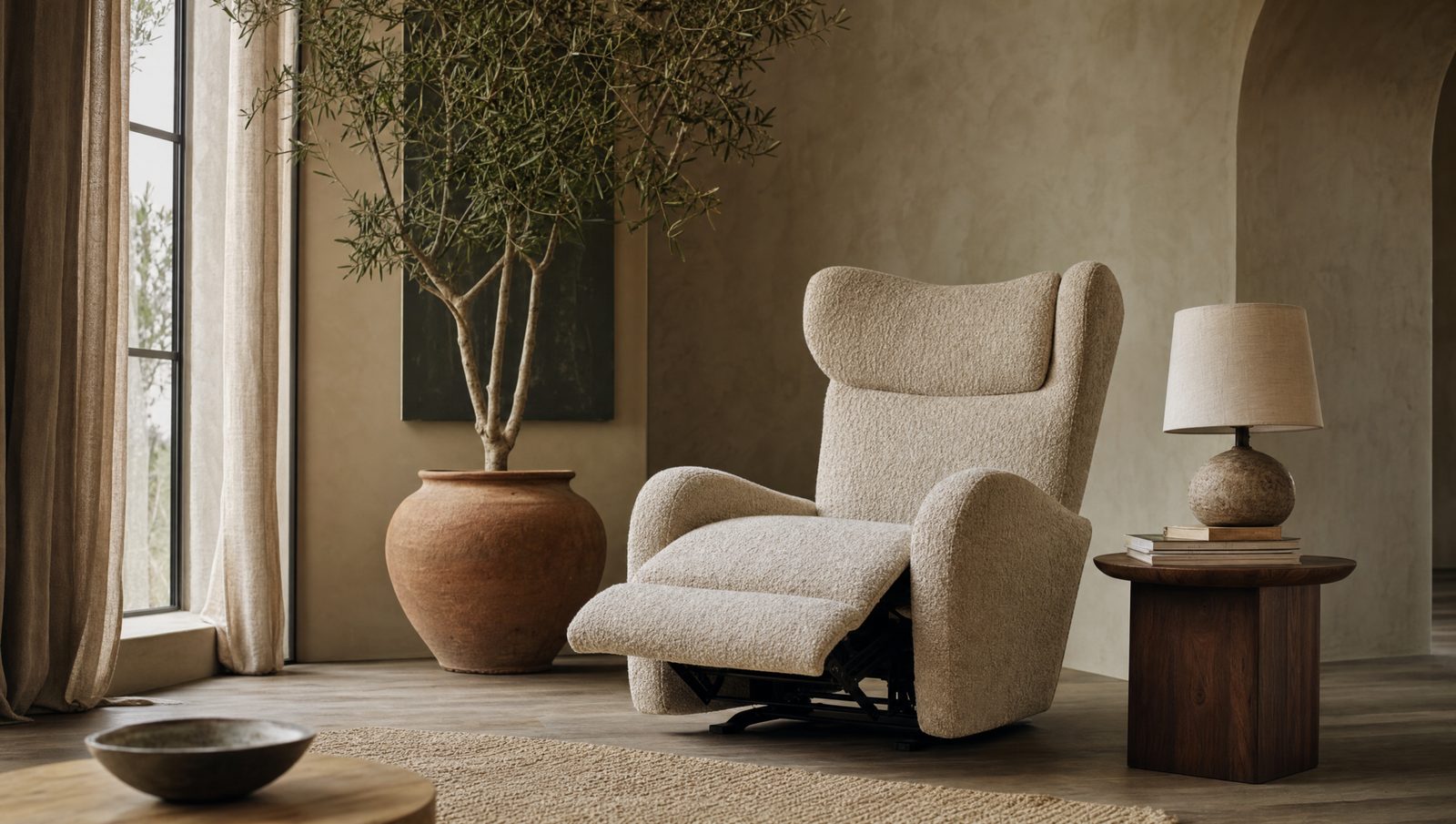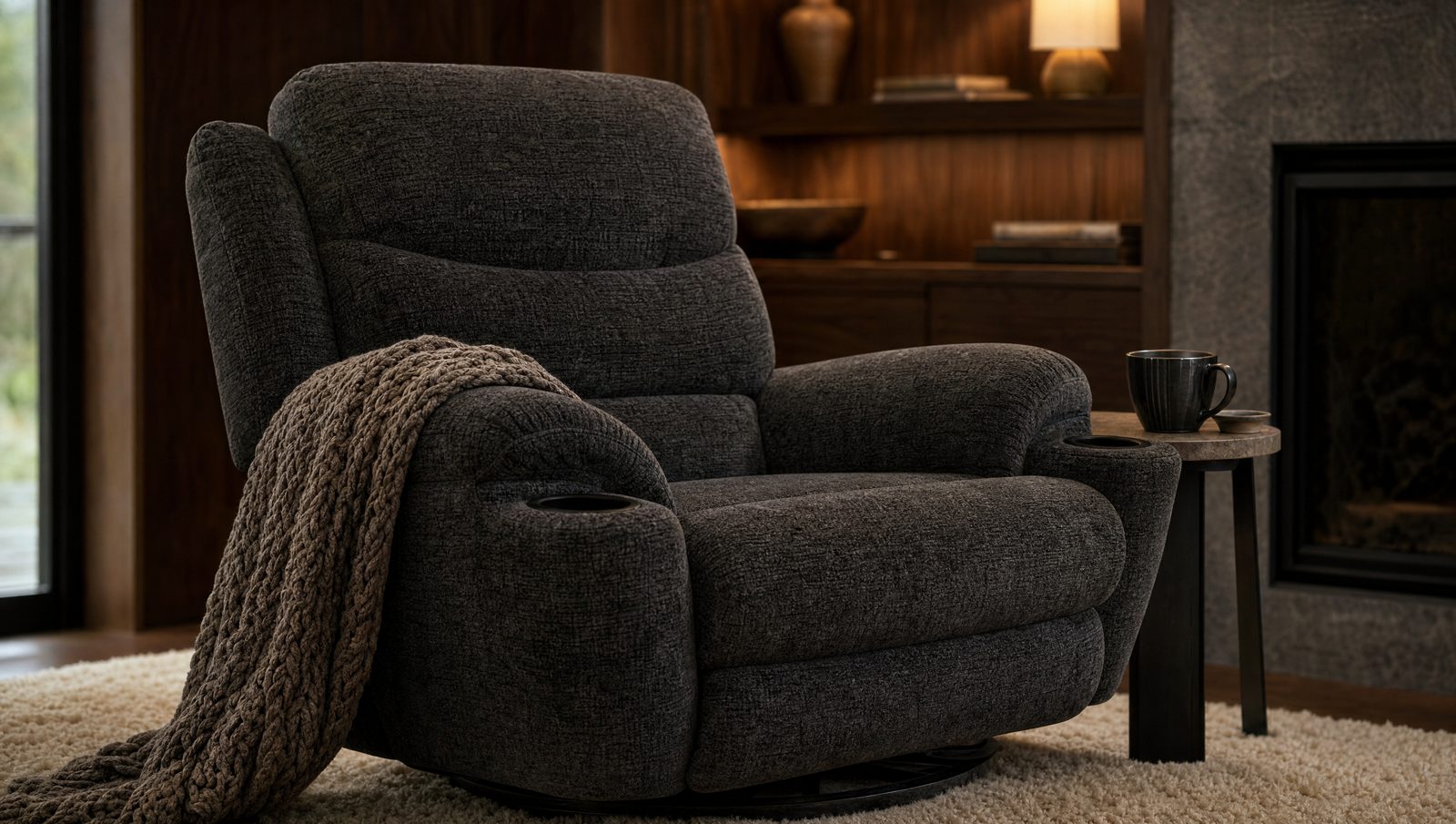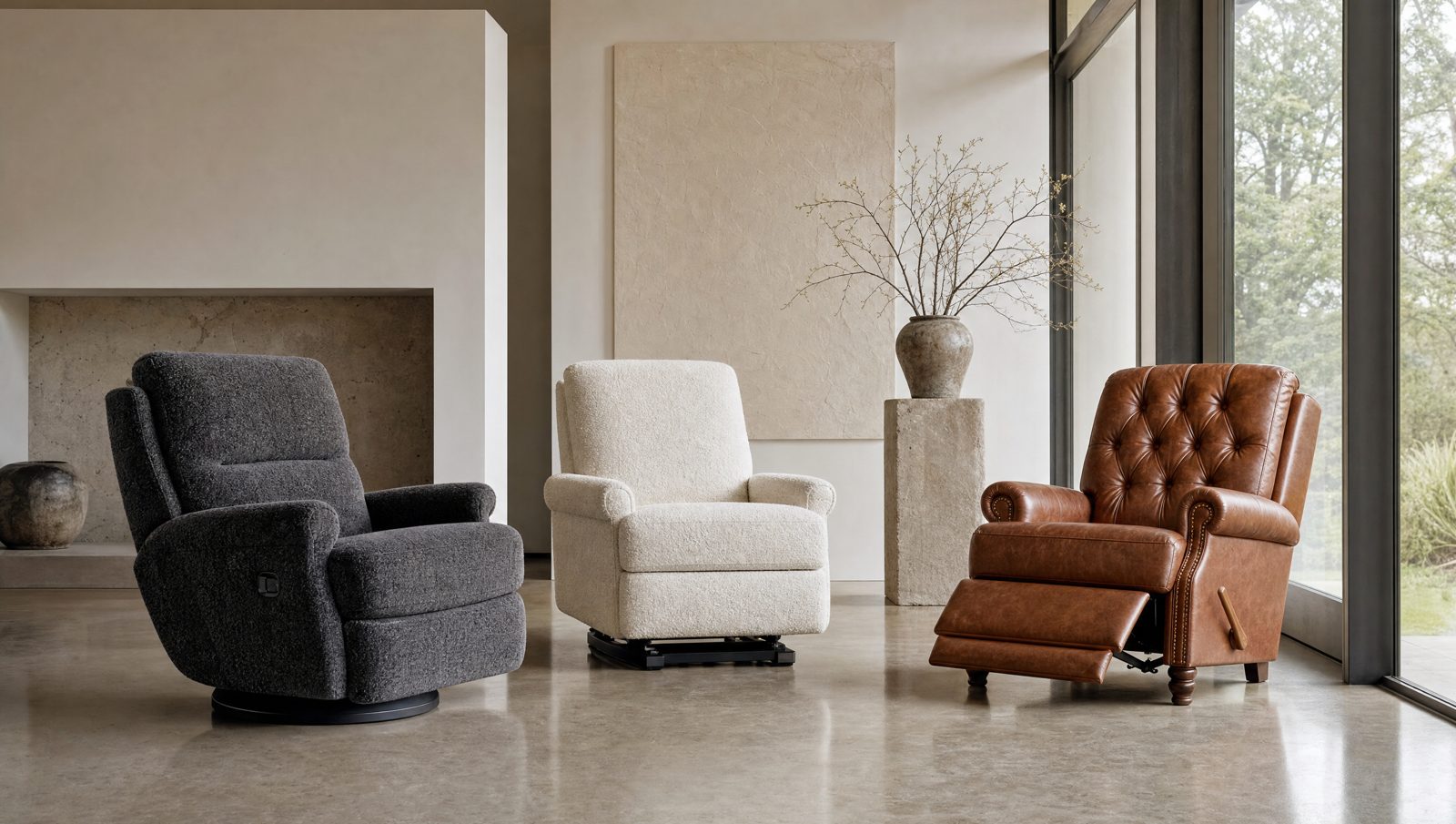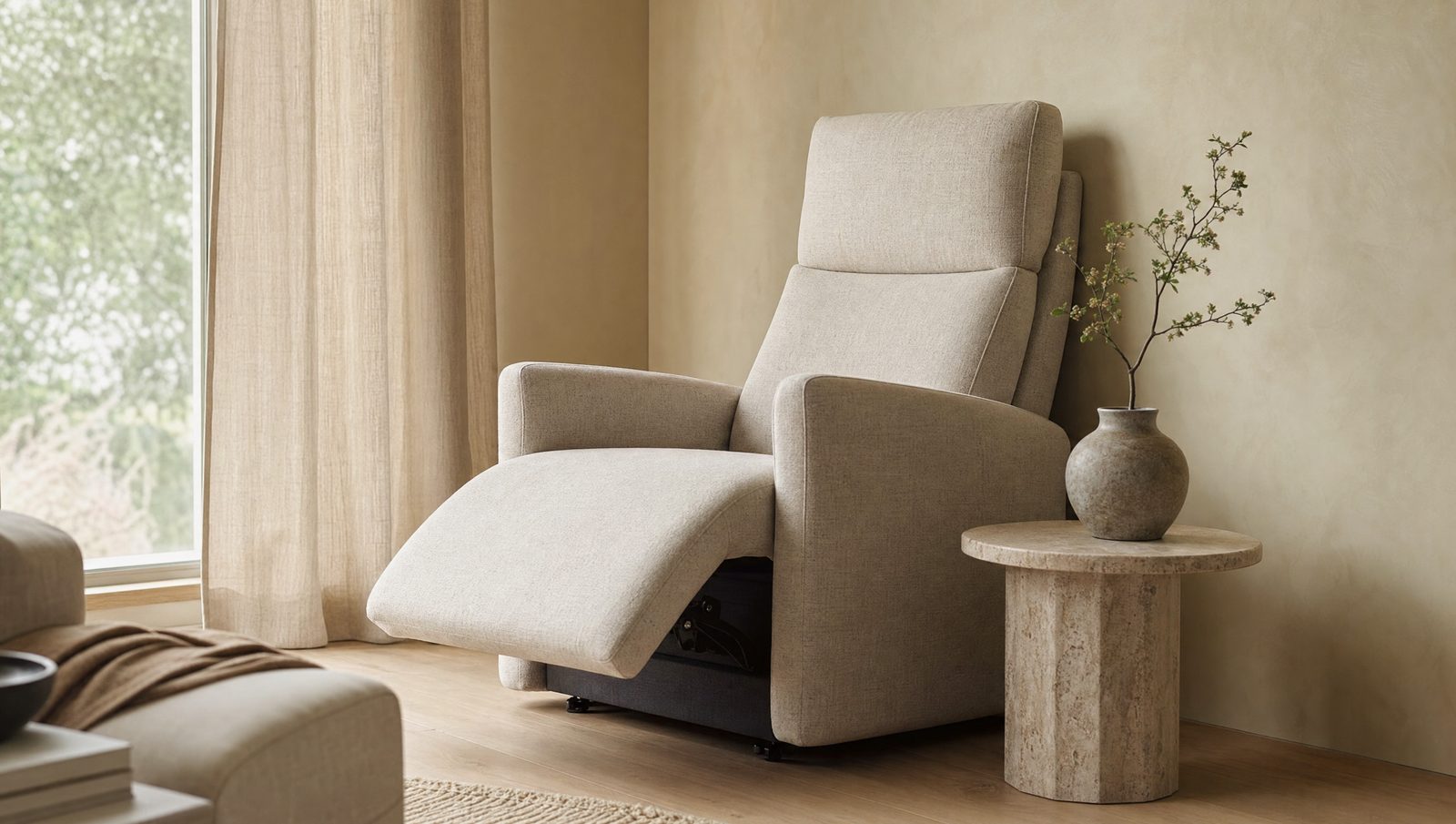
A wall hugger recliner slides its seat forward on a track as it reclines, so the back needs only about 3–7 inches of space behind it instead of the 12 inches or more most standard recliners need. It suits chairs pushed against a wall in small rooms. The trade-off: wall huggers don't rock or swivel.
Most recliners recline by tipping backward. The backrest swings toward the wall behind it, and unless you leave a generous gap, it gets there. The wall hugger solves that problem with a simple idea: instead of going back, the chair goes forward. It's one of the most useful mechanisms in the category, and one of the most loosely marketed. The same thing is sold as a "wall saver", "zero wall", "wall-away", "wall recliner" or "proximity" recliner, and the clearance figures in the marketing copy don't always match the spec sheet.
This guide explains how the mechanism works, what it costs you in comfort and features, and who should buy one. It is based on published manufacturer and retailer specifications, not hands-on testing. Every number below comes from a seller's listing, and where a seller doesn't publish a figure, we say so.
How a wall hugger recliner works
On a conventional recliner, the seat and back pivot together around a point near the base. As you lean back, the top of the backrest travels backward in an arc, which is why these chairs need a foot or more of open space behind them.
A wall hugger adds a second motion. The chair body sits on a track or rolling linkage on top of a fixed base. When you recline, the whole seat glides forward first, then the back tilts. Because the pivot has moved away from the wall, the backrest finishes its arc in roughly the same place it started. La-Z-Boy's product pages describe it in exactly those terms: the "recline function moves chair slightly forward instead of back toward the wall." A La-Z-Boy dealer's explainer from Furniture Academy puts the typical clearance at about 4 inches, against roughly 8 to 20 inches for other recliner bases.
Two consequences follow. First, the space you save behind the chair doesn't vanish; some of it moves to the front, because the seat and footrest travel forward. Second, a mechanism that slides on a track can't also rock, glide or spin on its base, so wall huggers are almost always stationary chairs.
What the spec sheets actually say
We gathered the published space specs for seven wall-hugging recliners. The final two columns are our own arithmetic: wall-to-footrest depth is the wall clearance plus the fully reclined length, the true strip of floor the chair occupies when it's fully open. Minimum room depth adds an 18-inch walkway in front, the same rule we use in our recliner space guide.
| Recliner | Upright W × D × H (in.) | Seat depth (in.) | Fully reclined length (in.) | Wall clearance (in.) | Wall-to-footrest (in.) | Min. room depth (in.) |
|---|---|---|---|---|---|---|
| Ashley Bladewood Zero Wall Recliner | Not listed | 23 | 66 | 3 | 69 | 87 (7 ft 3 in.) |
| La-Z-Boy Apollo Wall Recliner (016757) | 38 × 37 × 42 | 21 | 64 | ≈7 | 71 | 89 (7 ft 5 in.) |
| Homesvale Wall Hugger Microfiber Recliner | 34 × 36 × 39.5 | Not listed | 67.2 | 4 | 71.2 | 89.2 (7 ft 5 in.) |
| La-Z-Boy Rowan Wall Recliner (016765) | 34 × 39 × 41 | 21 | 66 | ≈7 | 73 | 91 (7 ft 7 in.) |
| La-Z-Boy Lancer Wall Recliner (016515) | 37 × 40 × 41.5 | Not listed | 68 | ≈7 | 75 | 93 (7 ft 9 in.) |
| La-Z-Boy Astor Wall Recliner (016519) | 37.5 × 41 × 44.5 | 21 | 70 | ≈7 | 77 | 95 (7 ft 11 in.) |
| Ashley Nerviano Wall Saver Recliner (1080329) | 33.5 × 37 × 42 | 20 | 69 | 12* | 81 | 99 (8 ft 3 in.) |
Sources: manufacturer and retailer listings, checked November 20, 2026. La-Z-Boy lists "fully extended" length and says its wall recliners can sit "approximately 7 inches" from a wall. *The Nerviano retailer spec table lists 12 in. between recliner and wall, while the product description says it needs "only a few inches." We use the larger figure. All specs can change, so confirm with the retailer before you buy.
Three things the table reveals
- Clearance varies more than the marketing suggests. The published figures run from 3 inches (Bladewood) to 12 inches (Nerviano's spec table). "Wall hugger" describes a mechanism, not a guaranteed number.
- Reclined length matters as much as clearance. The Astor needs 4 inches more clearance than the Bladewood, but its longer 70-inch extension is what pushes it 8 inches deeper overall. If you're tall, that extra length is the point; see our guide to recliners for tall people.
- The saving is real but modest. A standard recliner with the same 66-inch extension and a typical 12–18 inches of clearance would need 78–84 inches from wall to footrest. The Bladewood needs 69. That's 9 to 15 inches back, often the difference between a chair that fits a nook and one that blocks a doorway.
A worked example: the 7-foot-6 den
Say your den measures 90 inches from the back wall to the edge of a built-in console, and you want an 18-inch path in front of the open footrest. That leaves 72 inches for the chair, wall clearance included.
- A standard recliner that extends to 66 inches and needs 12 inches of clearance requires 78 inches. It won't open fully.
- The La-Z-Boy Apollo (≈7 + 64 = 71 inches) fits with an inch to spare.
- The Bladewood (3 + 66 = 69 inches) fits with 3 inches to spare.
- The Nerviano, if you trust its 12-inch spec-table figure (12 + 69 = 81 inches), doesn't.
Run your own numbers in the recliner fit calculator, and compare more models in our recliner dimensions database.
Wall hugger pros and cons
Pros
- Sits within roughly 3–7 inches of a wall on most published specs, so the chair can line a wall like a sofa.
- Frees usable floor in narrow living rooms, dens, apartments, bedrooms and RVs.
- Less likely to scuff paint or bump artwork, window sills and radiators behind it.
- Widely available in classic and tailored shapes, including power versions from major makers such as La-Z-Boy.
Cons
- No rocking, gliding or swivel. The track mechanism rules those out.
- Needs room in front: the seat moves forward as it reclines.
- Tends to cost more than an equivalent standard recliner, per La-Z-Boy's dealer explainer.
- Clearance claims are inconsistent; you have to read the spec table, not the headline.
Who should buy a wall hugger recliner?
Use this checklist. If you tick two or more boxes in the first group and none in the second, a wall hugger is very likely the right mechanism.
| A wall hugger makes sense if… | Look elsewhere if… |
|---|---|
| The chair must sit against a wall, a window or a radiator | You want to rock, glide or turn toward a TV or a window |
| Your wall-to-obstacle distance is under about 90 inches | The chair will float in the room with space all around |
| You're furnishing an apartment, a den, a bedroom corner or an RV | You're shopping for a nursery and want motion to soothe a baby |
| You'd rather not move the chair forward every time you recline | You need a lift mechanism to help you stand (that's a lift chair, a different category) |
For a full side-by-side of the other mechanisms, read swivel rocker vs. glider vs. recliner.
Where our #1 pick fits, and where it doesn't
To be plain: our top overall recommendation, the Korser 360° Swivel Rocker Recliner, is not a wall hugger. It swivels a full 360° and rocks, which means it needs open space around it, and Korser doesn't publish a wall-clearance figure. If your chair has to sit tight against a wall, choose one of the wall-hugging models above.
If you do have room to float a chair, and rocking, turning or the Korser's built-in heat and massage appeal more than a few saved inches, it remains the chair we rank first in our top rated recliners guide, with a published 385 lb capacity and a 22.8-inch seat depth.
Buying a wall hugger: five checks before you order
- Find the spec-table clearance, not the slogan. Look for "distance from wall" or "wall clearance" in inches. If it isn't listed, ask the seller, or don't count on it fitting flush.
- Find the fully reclined length. Add it to the clearance and an 18–24-inch walkway, and compare the total with your measured floor.
- Check seat depth against your height. The models above run from 20 to 23 inches; shorter people usually prefer the shallow end, taller people the deep end.
- Decide on manual or power. Power wall recliners need an outlet within cord reach, ideally behind the chair. Some listings mix manual and power wording, so confirm which version you're buying.
- Confirm it's still sold. Wall recliner lines change often. Of the listings we checked, La-Z-Boy's Lennon wall recliner was marked discontinued and the Bladewood showed as unavailable at one major retailer.
Frequently asked questions
How far from the wall does a wall hugger recliner need to be?
On published specs, most wall huggers need about 3 to 7 inches between the chair back and the wall. La-Z-Boy lists about 7 inches for its wall recliners, and one Ashley zero-wall model lists 3 inches. Some listings give more, so always check the spec table.
Do wall hugger recliners rock or swivel?
Almost never. The seat slides forward on a track as it reclines, and that mechanism rules out rocking, gliding and swiveling. If you want motion, look at a swivel rocker or glider recliner instead.
Are wall hugger recliners less comfortable?
Not inherently. The recline angle and footrest are similar to a standard recliner; the difference is where the chair moves. Comfort depends more on seat depth, back height and cushioning than on the wall-hugging mechanism.
Is a wall hugger the same as a zero wall or wall saver recliner?
Yes. Wall hugger, wall saver, zero wall, wall-away, wall recliner and proximity recliner are different brand names for the same forward-gliding mechanism.
Do wall huggers need space in front?
Yes. Because the seat moves forward as it reclines, you still need room for the fully reclined length plus an 18 to 24 inch walkway in front of the footrest.
As an Amazon Associate we earn from qualifying purchases. This doesn’t change our rankings. We rank products using published specifications and owner feedback; see how we rank.