Choose manual if opening and closing the chair is easy for you and you want the fewest parts to fail. Choose power if levers or leg pushes are difficult, or you want the back and footrest to stop at any angle. Power adds weight, needs an outlet or battery pack, and its motors usually carry shorter warranties than the mechanism.
The choice between power and manual is less about luxury than about mechanics. Both chairs share the same frame, springs and linkage; the power version simply swaps your arm or legs for a small motor, a transformer and a control panel. That substitution changes four things that matter: how easily the chair moves, where it can stand, how much it weighs, and how long the parts most likely to fail are covered. Below we compare them on published specs and manufacturer warranties, not on impressions.
How each mechanism works
A manual recliner opens one of two ways: a side lever or pull handle that kicks up the footrest, or a "push-back" design where you lean against the back while pressing down through your legs. Either way, a spring-loaded linkage does the work and your body supplies the force. Closing it means pushing the footrest down with your calves.
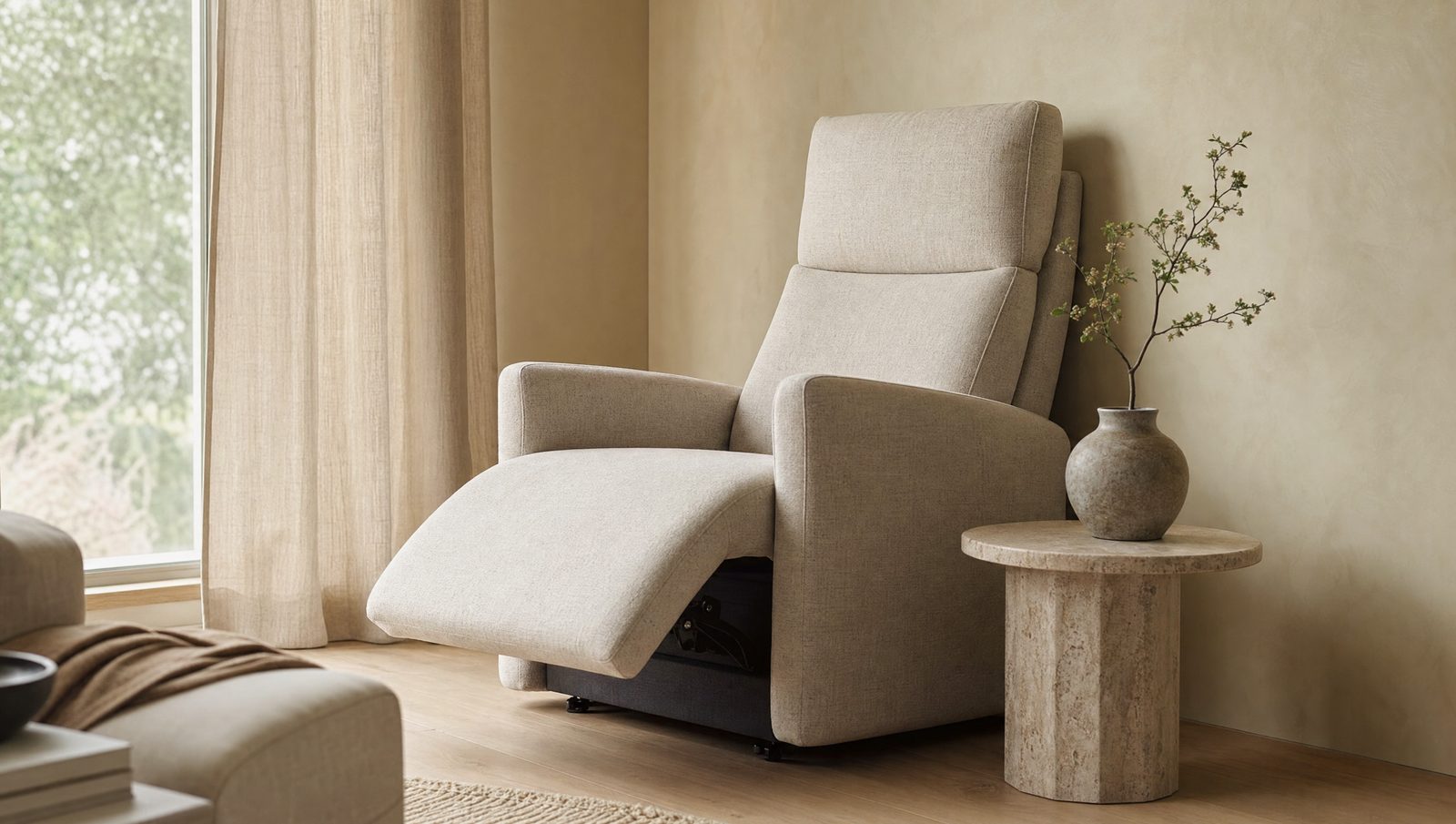
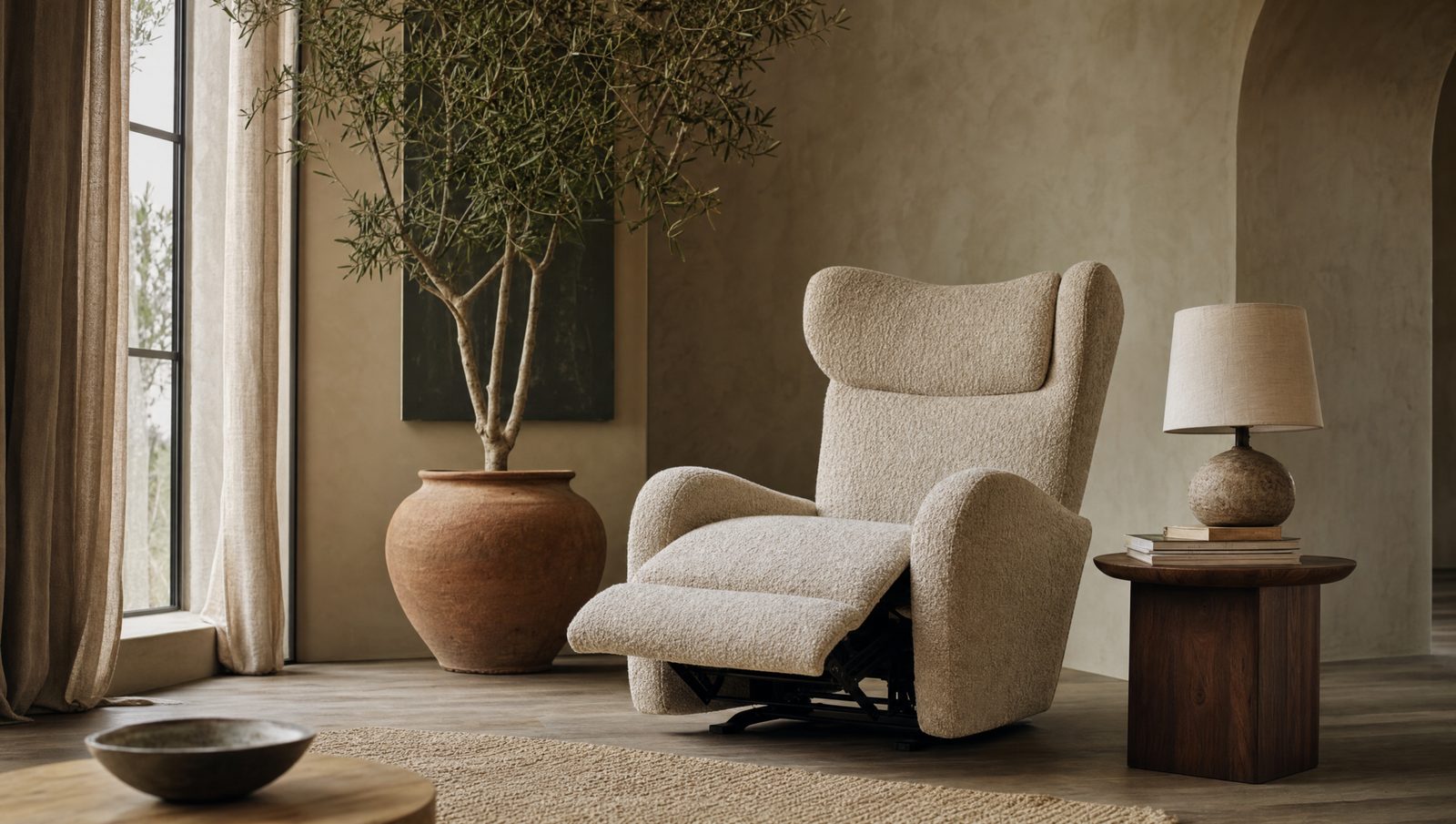
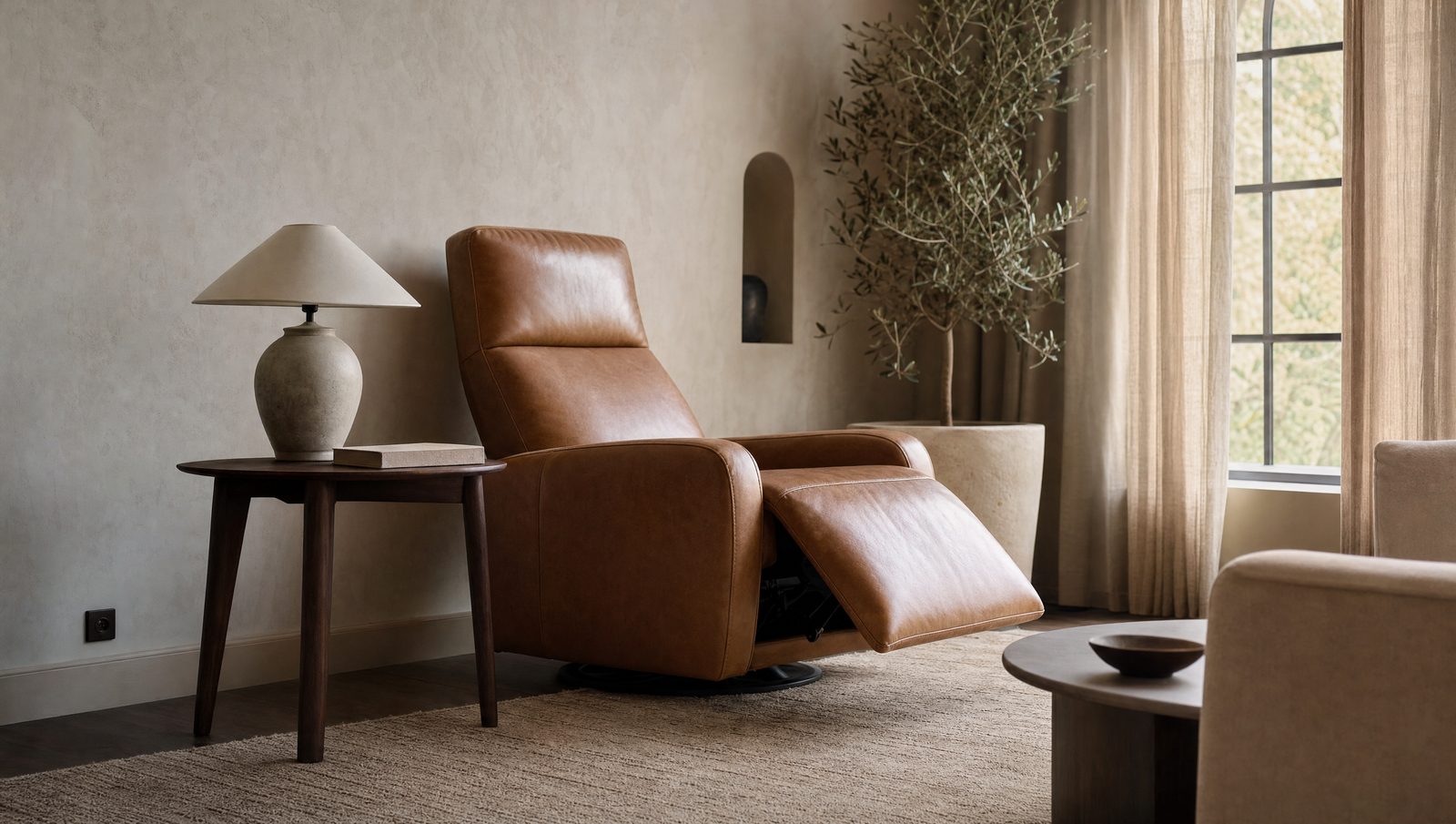
A power recliner drives that same linkage with an electric actuator. You press a button, the motor moves, and it stops wherever you release it. On better models the back and footrest move independently. La-Z-Boy's Pinnacle Power Wall Recliner, for example, uses a side-mounted four-button panel and lets the back recline "with or without raising the legrest," according to its product page. Many power chairs add a powered headrest and lumbar, and a USB port, because the electrics are already there.
One chair, two versions: the specs side by side
The cleanest way to see what power adds is to compare the same model built both ways. La-Z-Boy publishes full specifications for the Pinnacle in manual and power form, and we have recorded them in our Recliner Dimensions Database.
| La-Z-Boy Pinnacle | Wall Recliner (manual, 016512) | Power Wall Recliner (P16512) | Power Wall w/ Headrest & Lumbar (16X512) |
|---|---|---|---|
| Overall W × D × H (in.) | 33 × 38.5 × 41 | Not listed | 31 × 38.5 × 41 |
| Seat width / depth (in.) | 19 / 21.5 | Not listed | 19 / 21.5 |
| Seat height (in.) | 18.5 | Not listed | 18.5 |
| Fully extended length (in.) | 66 | 66 | 64.5 |
| Chair weight (lb) | 78 | 89 | 90.5 |
| Adjustment | Manual recline | Back and legrest independently; 4-button panel; USB | Power back, legrest, headrest and lumbar; USB |
| Needs | Nothing | AC outlet (battery pack optional) | AC outlet (battery pack optional) |
Specs from la-z-boy.com product pages, checked November 22, 2026. La-Z-Boy notes that handcrafted dimensions can vary.
Three things stand out. First, the footprint barely changes: the seat is identical, and the fully extended length is the same 66 in. for the basic power version. Second, power adds weight, 11 lb on the basic power model and 12.5 lb on the headrest-and-lumbar version, or roughly 14–16% more chair to carry up a staircase. Third, the power version earns its keep through control rather than size: independent back and legrest movement gives you reading, napping and feet-up positions that a single-lever manual chair cannot hold.
Effort and access: the real reason to go power
Manual recliners ask for a brief burst of strength at both ends of the motion: grip and pull to open, and a firm push with the calves to close. For most adults that is trivial. For someone with weak hands, painful knees or limited leg strength, it can be the difference between using the chair and avoiding it. Owner feedback on manual chairs, including our top pick, regularly mentions a recline that feels stiff; in our Korser review, a firm manual recline is one of the two weaknesses we flag.
Power removes that effort entirely. It also lets you stop at any angle, which helps people who find fully flat uncomfortable. If standing up from the seat is the problem rather than reclining, a standard power recliner will not help; that is the job of a lift chair, which tilts the whole seat forward. We will cover that distinction in its own guide.
Placement: outlets, cords and battery packs
A power recliner has to reach electricity. According to a La-Z-Boy dealer's guide to its battery packs, standard La-Z-Boy power cords run about 5 to 6 feet, and dealers advise against extension cords, adapters and surge protectors. That makes outlet position part of your floor plan.
Worked example: will the cord reach?
- Measure from the nearest outlet to the spot where the chair's power box will sit (usually under the rear of the seat). Say it is 7 ft.
- Subtract slack for routing the cord along the floor and behind the chair; allow about 1 ft. You now need roughly 8 ft of reach.
- Compare with a 5–6 ft cord: it falls short. Your options are to move the chair, add a floor outlet, or use a rechargeable battery pack, not an extension cord.
The same dealer says a fully charged La-Z-Boy battery pack typically lasts over a week at about ten reclining cycles a day, and keeps roughly 20% of its charge after four months unused. If you recline four times a day, a simple proportional estimate suggests two weeks or more between charges, though use of the USB port and full-range movements will shorten that. La-Z-Boy's packs work with its power recliners and sofas but not with its lift chairs.
Manual chairs have none of these constraints. They can float in the middle of a room, sit beside a window with no outlet, or move house without anyone hunting for a socket. If you plan to use the room flexibly, that freedom is worth more than it first appears. Our space guide and fit calculator will tell you whether the chair fits; the outlet check above tells you whether it works there.
Wall clearance
Power and "wall-saver" design often travel together. Because a motor can slide the seat forward as the back reclines, many power models are built to sit close to a wall; La-Z-Boy says its Pinnacle Power Wall Recliner can be placed "mere inches from a wall." Manual wall-hugger mechanisms exist too, and our wall hugger guide compares seven of them, with published clearances from 3 to 12 in. So power is one way to save space, not the only one.
Reliability and warranty: where the difference shows
A manual recliner's moving parts are a steel linkage and springs. A power recliner has those plus a motor, a transformer, a control panel or remote and the wiring between them. More parts mean more points of failure. A La-Z-Boy dealer writes that most power-furniture problems trace back to power supply or connection faults, such as an unplugged cord or a loose cable under the chair, rather than a dead motor, which is good news for repairs.
Manufacturers' warranties tell the story more objectively. They show how long each maker is willing to stand behind the mechanism versus the electrics.
| Brand | Reclining mechanism | Power / electrical parts |
|---|---|---|
| La-Z-Boy | Lifetime (parts) | 3 years (parts); 1 year labor |
| Flexsteel | Lifetime | 5 years; battery packs 1 year |
| HomeStretch | Lifetime (manual, power and lift) | Power-recline motors and remotes 1 year |
| Best Home Furnishings | Lifetime | Motors, hand wands, AC adapters 3 years |
| Bradington-Young | 5 years | Power recline function 3 years |
| England | 5 years | Power and lift mechanisms 1 year |
| Hooker | 5 years | Motorized parts 5 years |
| BarcaLounger | 3 years | Power and electrical 1 year |
| Craftmaster | 3 years | Power motion motors 3 years; other electrical 1 year |
| Decor-Rest | 3 years | Electronic components 1 year |
Sources: La-Z-Boy warranty (residential upholstered furniture); other brands as summarised in Woodstock Furniture's warranty guide. Terms change by model and purchase date; always read the card that ships with your chair.
Across these ten brands, the power components are covered for a shorter period than the reclining mechanism in eight. The median power coverage is three years; four of the ten put a lifetime warranty on the mechanism. Note, too, that "lifetime" typically refers to parts: La-Z-Boy covers labor for one year, and Flexsteel states that after the first year the buyer pays labor and shipping on repairs. The practical reading is that manufacturers themselves expect the electrics, not the linkage, to be the first thing that needs attention.
Safety around children and pets
Every recliner has pinch points, but motors add force. In a letter to ASTM's furniture safety subcommittee, the U.S. Consumer Product Safety Commission cited 13 incidents, seven of them fatal, involving children aged eight months to five years between 2011 and 2021, as reported by the American Home Furnishings Alliance. One hazard pattern was entrapment in the footrest mechanism from beneath the chair, which the CPSC said is compounded when the lift is motorized. If small children or pets share the room, keep the chair upright when no one is in it (Flexsteel's care instructions say the same), look for models with a safety stop, and unplug or lock out the controls if the model allows.
One safety point favours power, however: in an outage, a power recliner can be stuck reclined. La-Z-Boy dealers recommend keeping a 9V battery in the power pack, which lets the chair return upright when the mains fail. For anyone with limited mobility, check that a model offers this before buying.
Decision matrix: which should you buy?
| Your situation | Better fit | Why |
|---|---|---|
| Weak grip, sore knees or limited leg strength | Power | No pulling or pushing; stops at any angle |
| You read, nap and watch TV in the same chair | Power | Independent back and legrest hold in-between positions |
| No outlet within about 5 ft of the spot | Manual (or power + battery) | Avoids extension cords |
| You want a swivel or rocking base | Often manual | Check the power version: La-Z-Boy's Pinnacle rocks in manual form, but its power version is a wall recliner |
| Upstairs apartment, frequent moves | Manual | Lighter (11–12.5 lb less on the Pinnacle) and no cords |
| Want the fewest things to fail | Manual | Mechanism-only; usually the longest-warrantied part |
| Toddlers or pets in the room | Either, with care | Keep closed when empty; prefer safety-stop or lockable controls |
| Hard to stand up from a seat | Neither: a lift chair | Only a lift chair tilts you to standing |
Where our top pick fits
Our #1 recliner overall, the Korser 360° Swivel Rocker, is a manual chair, and that is part of its appeal: it swivels a full circle and rocks through 30°, motions that most power recliners give up, and its recline needs no motor to fail. It also adds lumbar heat and six-point vibration; check the listing for how those features are powered before deciding where it will go. The trade-off is the one this guide describes. Owners report the recline can feel firm, so if pushing back with your legs is difficult, a power model will serve you better. If it isn't, the Korser's 385 lb rating and 22.8 in. seat make it a strong manual choice for average to tall adults (shorter readers should check our seat depth guide first).
Buyer's checklist
- Try the motion you'll use most: open and close a manual chair several times, or time how long a power chair takes to go flat and back.
- Measure outlet distance before ordering a power model, and budget for a battery pack if it falls short.
- Read the warranty card for the motor, transformer and remote, not just the frame and mechanism, and note who pays labor after year one.
- Ask whether the power model has an outage backup (such as a 9V battery) and a safety stop.
- Check the chair's weight against your stairs and doorways, then its reclined length against the room with our fit calculator.
For our full ranking of recliners across both types, see our guide to the top rated recliners.
Frequently asked questions
Is a power recliner worth it over a manual one?
It is worth it if pulling a lever or pushing the footrest closed is difficult for you, or if you want the back and footrest to stop at any angle. If a manual chair opens and closes easily for you, manual gives you fewer parts to fail, less weight and no need for an outlet.
Do power recliners break more often than manual recliners?
They have more parts that can fail: a motor, transformer, controls and wiring. Most manufacturers warranty those parts for less time than the reclining mechanism, often one to five years versus lifetime coverage for the mechanism. Many reported faults are loose connections or power supply issues rather than dead motors.
Can a power recliner work without being plugged in?
Only with a rechargeable battery pack. La-Z-Boy dealers say its pack typically lasts over a week at about ten reclines a day. Dealers advise against extension cords and surge protectors. Some models also take a 9V backup battery so the chair can return upright in a power outage.
Does a power recliner need more wall space than a manual one?
Not necessarily. Many power recliners are wall-saver designs that sit a few inches from a wall; La-Z-Boy's manual Pinnacle Wall Recliner and its power version both list a 66 in. fully extended length. Check each model's published wall clearance and reclined length.
Is the Korser swivel rocker power or manual?
It is a manual recliner with a 360° swivel and a 30° rocking range, plus lumbar heat and vibration massage. Owners report the manual recline can feel firm, so it suits people who can push back comfortably.
As an Amazon Associate we earn from qualifying purchases. This doesn’t change our rankings. We rank products using published specifications and owner feedback; see how we rank.