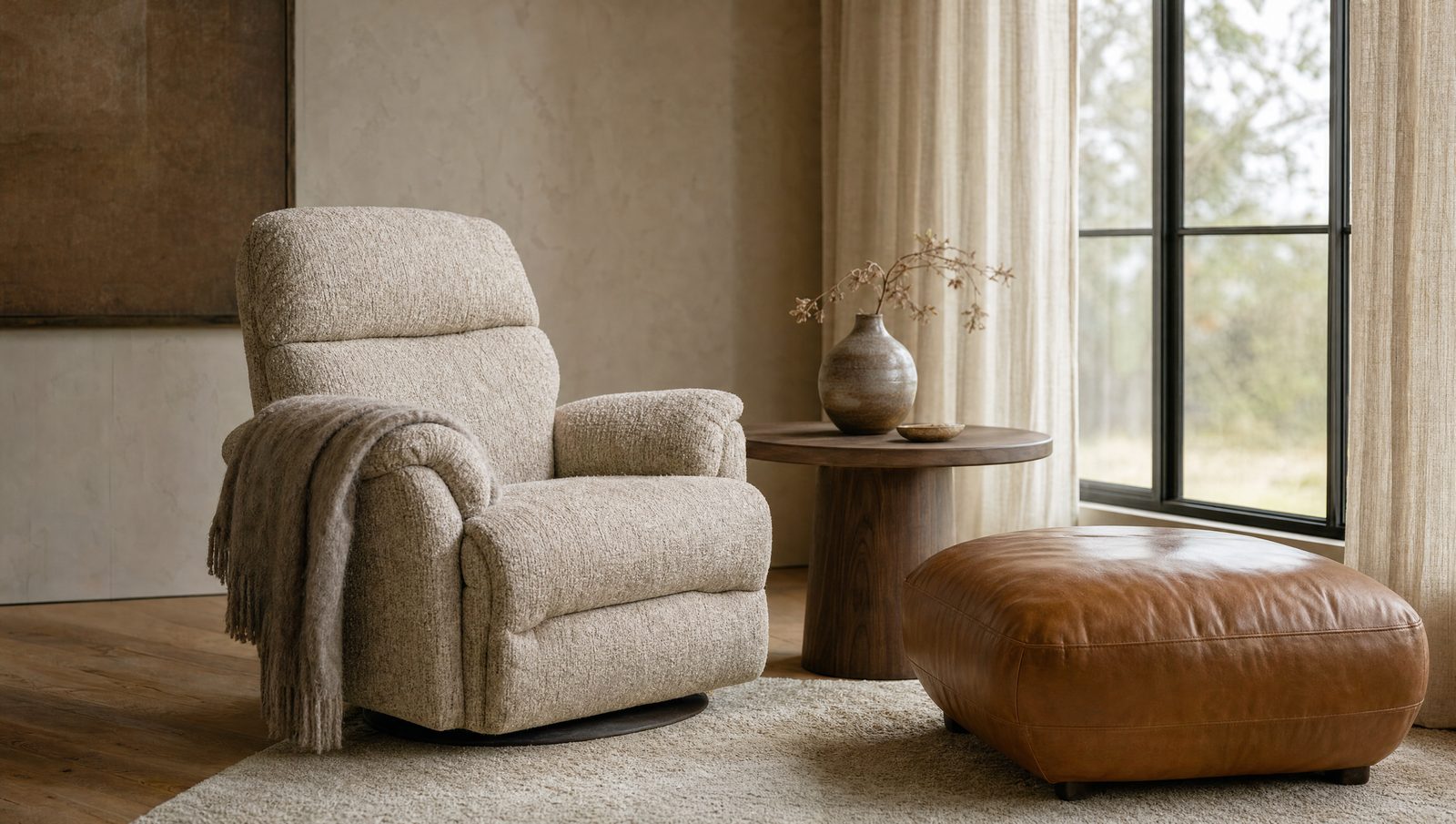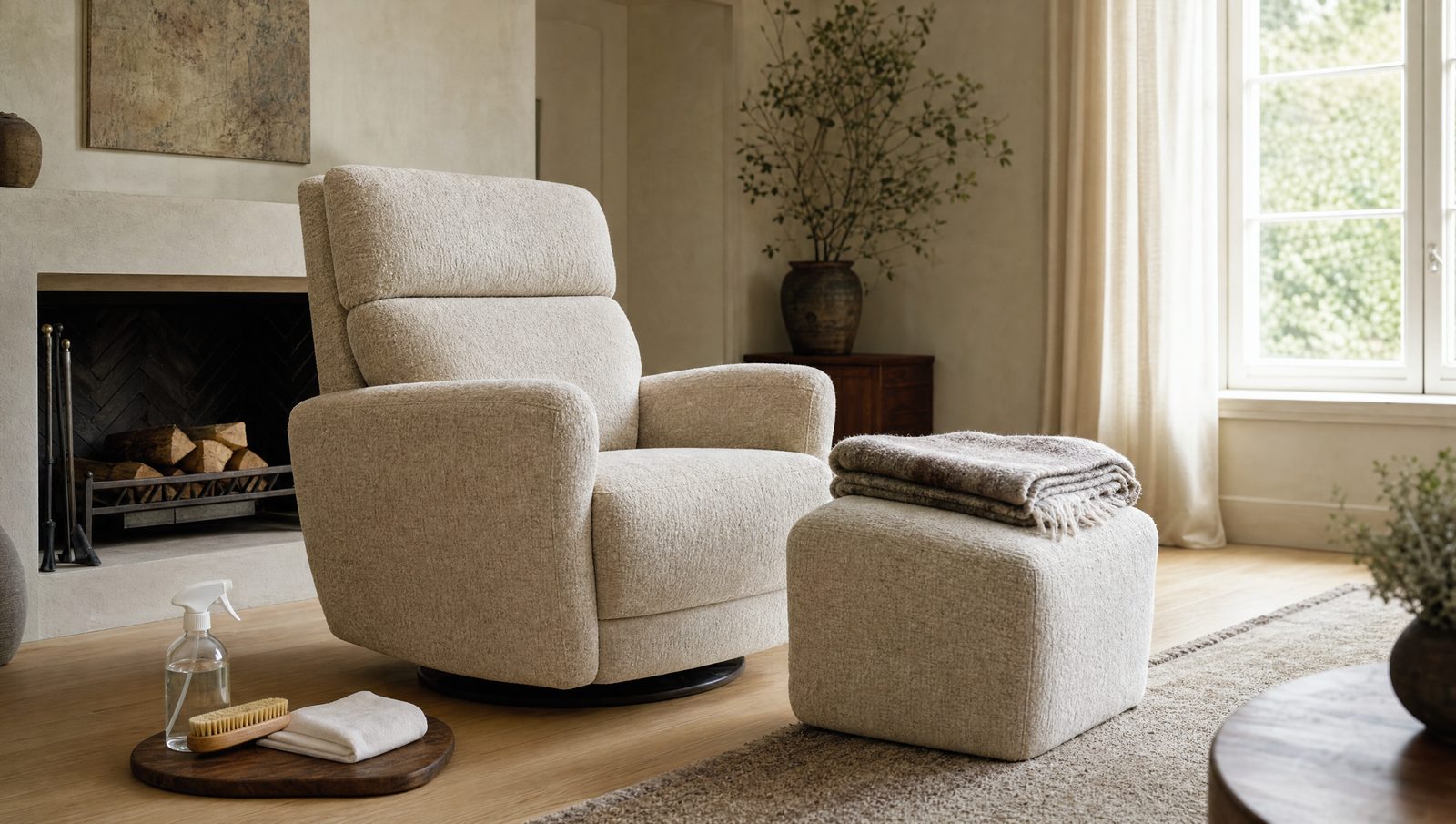
To clean a recliner, check the tag's cleaning code. Vacuum weekly, blot spills at once, and spot-clean W or W-S fabric with a weak detergent solution (about ¼ teaspoon per cup of water), working from the outside in. Use solvent only on S codes, nothing wet on X, and distilled water on leather. Unplug powered chairs first.
A recliner gets dirtier than a sofa in the same room. It is one person's chair, used for hours at a time, often with a plate or a mug on the arm, and its fabric is folded and stretched every time the footrest rises. Yet most of the damage owners describe comes not from the dirt but from the cleaning: water rings on microfiber, crushed chenille pile, a dull patch where a household spray took the finish off leather.
This guide sets out a method that avoids those mistakes. It is built from the published care instructions of La-Z-Boy, Crypton, Flexsteel and Pride Mobility rather than from hands-on testing, and it goes stain by stain. If you are still choosing a chair, our recliner fabric guide explains what chenille, microfiber and "performance" labels mean and how to read the code before you buy; here we assume the chair is already in your living room.
Step one: read the tag, and the chair
Most upholstered recliners carry a care label with a cleaning code, usually stitched under the seat cushion or on the underside of the frame. The single letter on it decides everything that follows. La-Z-Boy's care page summarizes the four codes this way:
- W: water-based shampoo or foam only. No solvents, no steam or hot-water extraction, and covers are not laundered.
- S: water-free dry-cleaning solvent only. Water itself can mark these fabrics.
- W-S (also written SW): either water-based cleaner or solvent, chosen by the stain.
- X: no liquid or foam cleaner of any kind. Vacuum or brush lightly; anything more is a job for a professional.
Then look at the chair itself. Three things change the method: whether the fabric has a pile (chenille, velvet), whether the cover is leather, faux leather or a leather match (real leather on the seat, vinyl on the sides), and whether anything plugs in. A power recliner, a lift chair or a manual chair with a heated or vibrating lumbar pad all have wiring, connectors and a transformer that must stay dry.
What should you clean a recliner with?
Fewer products than you might think. Every fabric method we found begins with plain water and the mildest detergent that works, applied sparingly. Published recipes differ in strength, so we converted them to a common measure.
| Source and fabric | Published recipe | Teaspoons per cup of water | Detergent in a 16 oz spray bottle | Approx. concentration |
|---|---|---|---|---|
| Crypton (performance fabric) | ¼ tsp mild detergent in 1 cup lukewarm water | 0.25 | ½ tsp | ~0.5% |
| La-Z-Boy iClean (performance fabric) | 1 tsp liquid detergent in 16 oz water | 0.5 | 1 tsp | ~1% |
| Sailrite's guidance for Crypton | 1 tsp detergent in 16 oz warm water | 0.5 | 1 tsp | ~1% |
| La-Z-Boy (leather spills) | Half mild soap, half distilled water, worked to a foam on a damp cloth | n/a | n/a | ~50%, but applied as foam, not sprayed |
Our arithmetic: 1 US teaspoon ≈ 4.93 mL and 1 cup ≈ 236.6 mL, so ¼ tsp per cup ≈ 0.52% and ½ tsp per cup ≈ 1.04%. A 16 oz bottle holds 2 cups.
The takeaway is that the gentlest published recipe is half as strong as the next. Crypton's own instructions say that less soap is better, because residue left in the fibers attracts new dirt and can leave a ring. Our suggestion: mix the weaker ¼-teaspoon-per-cup solution first, and move to the stronger one only if a stain survives two gentle passes. Keep a second bottle of plain water for rinsing; that is what lifts the soap back out.
Use white cloths throughout, so no dye transfers, and a soft, non-metallic brush. La-Z-Boy recommends a stiff non-metallic brush for routine brushing of pile fabrics and a soft one after spot cleaning performance fabric; metal bristles snag loops and pile.
How to deep-clean a fabric recliner, step by step
This is the routine for a W or W-S fabric chair that is generally grubby rather than stained in one place. Allow an afternoon, mostly for drying.
- Unplug it. If the chair has power recline, lift, heat or massage, disconnect it at the wall and at the transformer.
- Clear the mechanism. Raise the footrest, look into the gap between seat and arms, and remove coins, remotes and crumbs by hand before you vacuum. Recliners swallow small objects, and a vacuum nozzle pushed into a moving linkage can catch.
- Vacuum everything with an upholstery tool, then a crevice tool along every seam, under the footrest and along the back where it meets the seat.
- Test a hidden spot, such as the back panel near the floor, with your solution. Let it dry fully and check for color change or a ring.
- Mist, don't soak. Lightly mist one panel with plain water, then with the weak detergent solution. Oversaturation is the most common cause of water rings, and it soaks the foam beneath, which dries slowly.
- Work from the outside in with a white cloth or soft brush, so any tide line moves toward the center rather than spreading outward. Pride Mobility, writing about lift chairs, advises scrubbing left to right rather than in circles to avoid rings.
- Clean seam to seam. Finish a whole panel, edge to edge, rather than leaving a clean island in the middle of a seat.
- Rinse with the plain-water bottle and blot with a dry cloth until no more soap comes up.
- Dry and restore. Let the chair air-dry, with windows open or a fan running; don't recline it or plug it back in until it is dry. Then brush pile fabrics lightly in one direction to lift them.
On hot-water extraction (the rented carpet-cleaner approach), the manufacturers disagree. La-Z-Boy's code W guidance rules out steam and hot-water extraction; Crypton's own fabric instructions allow it, with hot water only and no cleaning solution, wetting the whole connected surface so that no edge marks form. Follow the brand on your tag, and if you don't know the brand, don't extract.
Stain-by-stain: what to do by cleaning code
The decision matrix below applies the published code rules to the stains recliner owners deal with most. Whatever the stain, the first move never changes: lift off any solids, then blot from the outside in with a dry white cloth. Never rub, which pushes the stain deeper and roughens the surface.
| Stain | Code W | Code W-S / SW | Code S | Code X |
|---|---|---|---|---|
| Coffee, tea, soda, juice, wine | Blot, then weak detergent solution, rinse, blot dry | Same as W | Blot only; solvent spot-cleaner, no water | Blot; call a professional |
| Food with solids (ketchup, ice cream, chocolate) | Scrape off excess, then as above | Same as W | Scrape, then solvent | Scrape and blot; professional |
| Grease, lotion, cosmetics, hair oil | Mild soap and water; repeat rather than strengthen | Light marks: mild soap and water. Heavy: a solvent spot remover, tested first, then soap-and-water rinse | Solvent spot remover | Vacuum only; professional |
| Ink | Mild soap and water; professional if it stays | Solvent spot remover after a spot test | Solvent spot remover | Professional |
| Pet accident (urine) | Blot thoroughly, weak detergent solution, rinse well | Same as W | Blot; professional, as water may mark | Blot; professional |
| General soiling on arms and headrest | Full-panel clean, seam to seam | Same as W | Professional dry clean | Brush and vacuum |
Built from La-Z-Boy's code W, S, W-S and X instructions and its iClean stain list, plus Crypton's spot-cleaning method. If your chair's own tag or manual says something different, the tag wins.
For oily marks on a water-safe fabric, Sunbrella's advice (as reproduced by Sailrite) is a useful first step: sprinkle cornstarch to draw the oil out, scrape it away with a straight edge, then clean with mild soap. Crypton also sells an enzyme cleaner aimed at pet messes. Enzyme products are water-based, so they belong only on W and W-S fabrics, and they deserve the same hidden-spot test as anything else.
Chenille and other pile fabrics
Chenille needs a lighter hand than flat weaves. Its tufted pile holds water, so mist even more sparingly, and press the cloth straight down rather than dragging it, which can pull loops or "track" the pile. Once dry, brush the whole panel in one direction with a soft, non-metallic brush so the cleaned area matches the rest. Brushing the seat and arms every week or two also helps slow the crushed, shiny patches that form where you sit most.
Microfiber
Microfiber's tight weave releases dry dirt and pet hair easily, so vacuuming does most of the work. Where it marks is with water: minerals left behind as tap water dries can leave a ring, which is why many microfiber care tags call for distilled water. Use distilled for both the solution and the rinse, and finish with a quick brush to lift the nap.
How to clean a leather recliner
Leather care depends on its finish more than on the hide. Flexsteel, which uses only semi-aniline and pigmented leathers, describes the three main types: aniline (natural, little or no protective finish, develops a patina, absorbs spills), semi-aniline (a light top coat for stain and fade resistance) and pigmented (a heavier coat and the most resistant). Most leather recliners are pigmented or semi-aniline.
- Weekly: dust or vacuum with a soft brush attachment, using the crevice tool in seams. La-Z-Boy then suggests a wipe with a soft, lint-free cloth barely dampened with distilled water.
- Spills: blot, don't rub. For anything sticky, La-Z-Boy's method is a half-and-half mix of mild soap and distilled water, worked to a foam on a damp cloth, then wiped off with clean distilled water and dried.
- Conditioner: manufacturers disagree. Flexsteel says there is no need to condition its finished leathers. Treat conditioner as something your brand's guide must ask for, not a habit.
- Scratches and fading: Flexsteel suggests a cream only for waxed or burnished leathers and a professional for finished ones.
- Position: keep the chair out of direct sun and at least 12 inches from radiators and heat sources, per La-Z-Boy, to slow drying and fading.
Faux leather (PU or vinyl) is a plastic coating, not hide, so conditioners have nothing to nourish. Wipe it with a damp cloth and mild soap, rinse and dry. Check the tag anyway: in our fabric research, one faux-leather recliner carried code X, which means vacuum only.
Power, lift and heated recliners: safety first
Any chair with a motor, heating pad or vibration unit adds rules. Pride Mobility, which makes lift chairs, tells owners to keep electrical connections and the external transformer away from moisture and body fluids, to unplug the power cord before cleaning the transformer or hand control, to use only a dry or lightly damp cloth on them, and to let everything dry fully before reconnecting. It also suggests checking wiring harnesses for damage and unplugging the chair if you find any.
In practice, clean upholstery near a heated lumbar zone or massage panel with the barest damp cloth, never a spray, and leave the chair unplugged until it is completely dry. Our power vs manual recliner guide covers the cord and battery components in more detail.
Where the Korser fits
Our top pick, the Korser 360° Swivel Rocker Recliner, is a soft chenille chair with lumbar heat and six-point vibration, so two parts of this guide apply: the light, pile-friendly method above, and the rule about keeping its heat and massage wiring dry. Its listing does not publish a cleaning code, so read the tag under the cushion when the chair arrives and note the letter before you need it. Based on its published specs and owner feedback, it remains the best all-round value we have found; see our massage recliner guide for how its heat and vibration compare.
A recliner care schedule
- Weekly: vacuum the cover and seams; brush pile fabrics; dust leather and wipe with distilled water.
- Immediately: blot any spill with a white cloth, from the outside in.
- Monthly: raise the footrest, clear the mechanism of debris, and look over the fabric for pulls and seams starting to open.
- Every few months: on power chairs, unplug and inspect the cord, connectors and transformer for damage.
- Once or twice a year, or when the whole chair looks dull: a full seam-to-seam clean, or a professional for S and X codes.
- Always: test any product on a hidden spot, and keep the chair out of direct sun.
Looked after this way, a recliner should stay presentable for the years its frame and mechanism are built to last. For the chairs we rate most highly, start with our guide to the top rated recliners.
Frequently asked questions
Can I use a carpet cleaner or steam cleaner on a recliner?
Only if the cleaning code and the brand allow it. La-Z-Boy rules out steam and hot-water extraction on code W fabric, while Crypton permits hot-water extraction (water only, no detergent) on its performance fabrics. If you don't know the brand, spot-clean instead.
How do I clean a recliner with code X?
Vacuum and brush lightly only. Code X means no water-based or solvent cleaner at all, so any stain beyond what blotting removes is a job for a professional upholstery cleaner.
Should I use distilled water to clean a recliner?
It is a good habit on microfiber and leather. Minerals in tap water can leave rings on microfiber, and La-Z-Boy's leather care instructions specify distilled water for wiping and rinsing.
Is it safe to clean a power or heated recliner?
Yes, if you unplug it first, keep moisture away from the cord, connectors, transformer, heating pad and hand control, use only a lightly damp cloth near them, and let the chair dry completely before plugging it back in.
Do leather recliners need conditioner?
Not always. Flexsteel says its finished (semi-aniline and pigmented) leathers do not need conditioning, while some brands recommend it. Follow your chair's own care guide, and never use leather conditioner on faux leather.
As an Amazon Associate we earn from qualifying purchases. This doesn’t change our rankings. We rank products using published specifications and owner feedback; see how we rank.